
Characteristics of Big Data
Before going deep into other topics, let us first understand the characteristics of big data and why it is important .
Data can be any shape, size format, it can be anything.
Big Data is best understood through the 5 V’s : Volume, Velocity, Variety, Veracity , and Value .
Each highlights a unique challenge in managing, processing, and deriving insights from modern data ecosystems.
Big Data isn't just about having a lot of data. It's about using it wisely . The 5 V's help you understand whether your data is fast, diverse, accurate, valuable — and ultimately, useful.
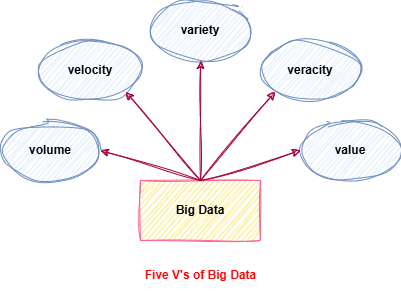
The 5 V’s of Big Data
|
Aspect |
Meaning |
Key Characteristics |
Real-World Examples |
Tools & Technologies |
|---|---|---|---|---|
|
Volume |
The scale or size of data generated and stored. |
|
|
Hadoop HDFS, Amazon S3, Azure Data Lake, Google Cloud Storage |
|
Velocity |
The speed at which data is generated, transmitted, and processed. |
|
|
Apache Kafka, Apache Flink, Apache Spark Streaming, AWS Kinesis, Azure Event Hubs |
|
Variety |
The diversity of data types, formats, and sources. |
|
|
MongoDB, Snowflake, Delta Lake, Elasticsearch, Databricks |
|
Veracity |
The reliability, quality, and accuracy of the data. |
|
|
Great Expectations, Deequ , Informatica, Talend, Collibra, Apache Atlas |
|
Value |
The usefulness and business impact of the data. |
|
|
Power BI, Tableau, Looker, AWS SageMaker, Azure ML, BigQuery , Snowflake, Databricks |
Why the 5 V’s of Data Matter ?
The 5 V’s— Volume, Velocity, Variety, Veracity, and Value —offer a structured way to understand and manage Big Data challenges . They help businesses and data teams:
Without this framework, teams risk investing in ineffective or inefficient data strategies.
Questions the 5 V’s Help Answer
|
Aspect |
What It Helps You Ask |
|---|---|
|
Volume |
|
|
Velocity |
|
|
Variety |
|
|
Veracity |
|
|
Value |
|
The 5 V’s aren’t just buzzwords—they’re decision lenses . They help teams ask the right questions before building data pipelines, choosing tools, or running models. If you can answer the 5 V’s, you're ready to build a data-driven strategy.
Understanding the 5 V’s helps you design smarter data systems, choose better tools, and focus on data that delivers real business value.